I dropped in at a writer's conference near Seattle this weekend, to spend some time with tale spinners and the people who help get those tales pubished. It was fascinating to hear how the publishing process works, and why it takes so long to hear back when you submit a manuscript. It was very inspiring being around so many writers, listening to success stories, and learning more about the business of writing.
Check out http://fiberinparadise.blogspot.com/ for a report from my friend who attended the full conference. While there be sure to read the rest of her blog, and you'll understand why she's had an agent and an editor request her manuscript.
It was a lovely weekend to be in the Puget Sound area. The Northwest has taken summer by the horns. It's been in the 80s and 90s, which is unusual for June. Actually, it doesn't usually stop raining until after July 4th. This spring has been wonderful. It's so beautiful here in spring and summer - the mountains gleem, the water glistens, and the lush green foliage looks positively tropical. Tonight a swift breeze is helping keep this web-footed northwesterner from melting. It was fun to spend some time in the city, but I'm glad to be back in my rural abode.
Sunday, June 25, 2006
Writer's Weekend
1 comments
 Labels:
Stories
Labels:
Stories
Saturday, June 24, 2006
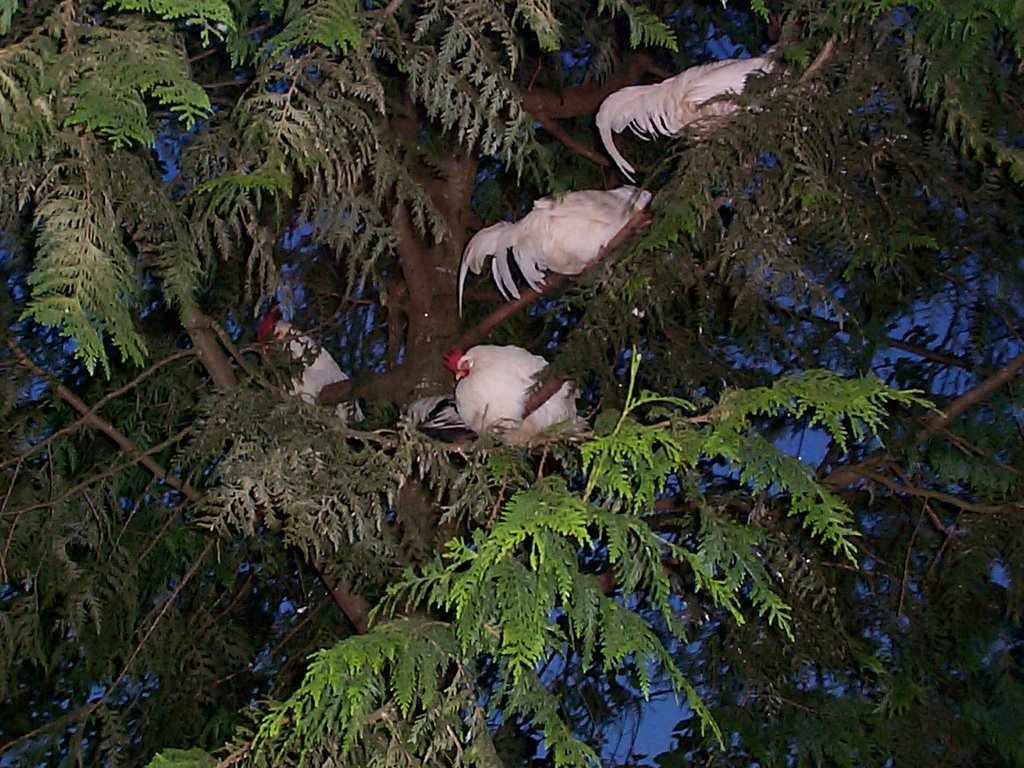
Elusive Peachicks


1 comments
Labels:
Birds,
Peafowl
Sheep Field in Bloom
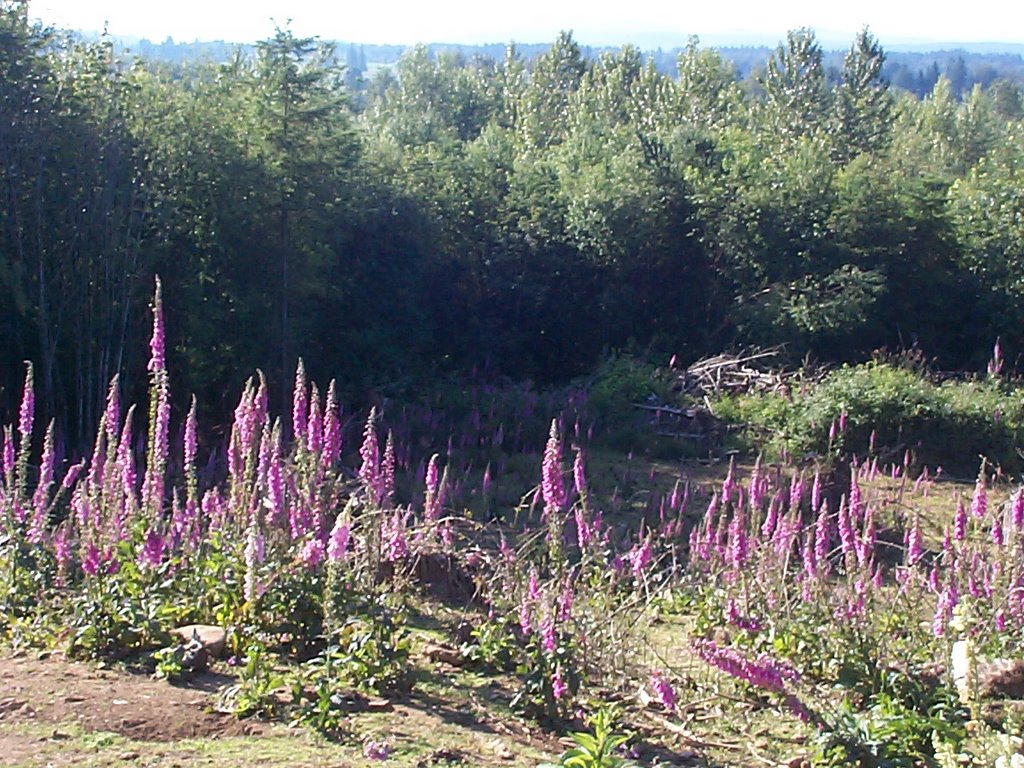 This is my sheep field with foxglove in full bloom. Not much room for grass, but it's lovely. Fortunately, the grass, berries, and other foliage along the lane is doing very well indeed, so the sheep still have fresh browse while they perform important mowing tasks.
Part of the road maintenance crew.
0
comments
Labels:
Donkey,
Plants
Thursday, June 01, 2006
Nature's Plan
When I moved here, my newly-widened lane was flanked with the red-brown clay that passes here for soil. I decided I needed to plant flowering trees along it, to brighten up the woods and hopefully help keep back the blackberries. I started this winter, planting a few lilacs. And then the Elderberries came into bloom. The Elderberries that seem to sprout up wherever there is disturbed soil, and that now line sections of the lane. Their creamy white blossoms cheerily announced spring.
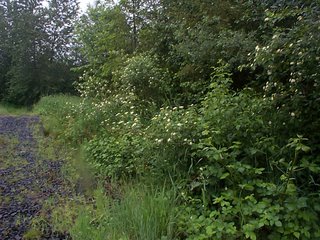 Other native trees are now taking on the brightening duties, with flowers (I think these are Oregon Boxwoods) and colorful seed pods.
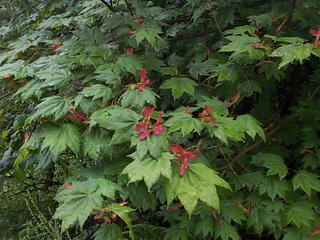 Some scrappy-looking plants have been establishing themselves in the clay. I'd been wondering what they were and if it was wise to let something that spread so fast to take hold, but decided anything was better than the Himalayan blackberries that are the bane of the Northwest. They then put on a growth spurt and turned into flows of delightful long-stemmed greenish-white and pink flower stalks. Tellima grandiflora or fringecup, a northwest native described as "somewhat aggressive", seems to be out-competing everything. Pretty pink claytonia sibirica, a purslane called candy flower, adds color interest.
 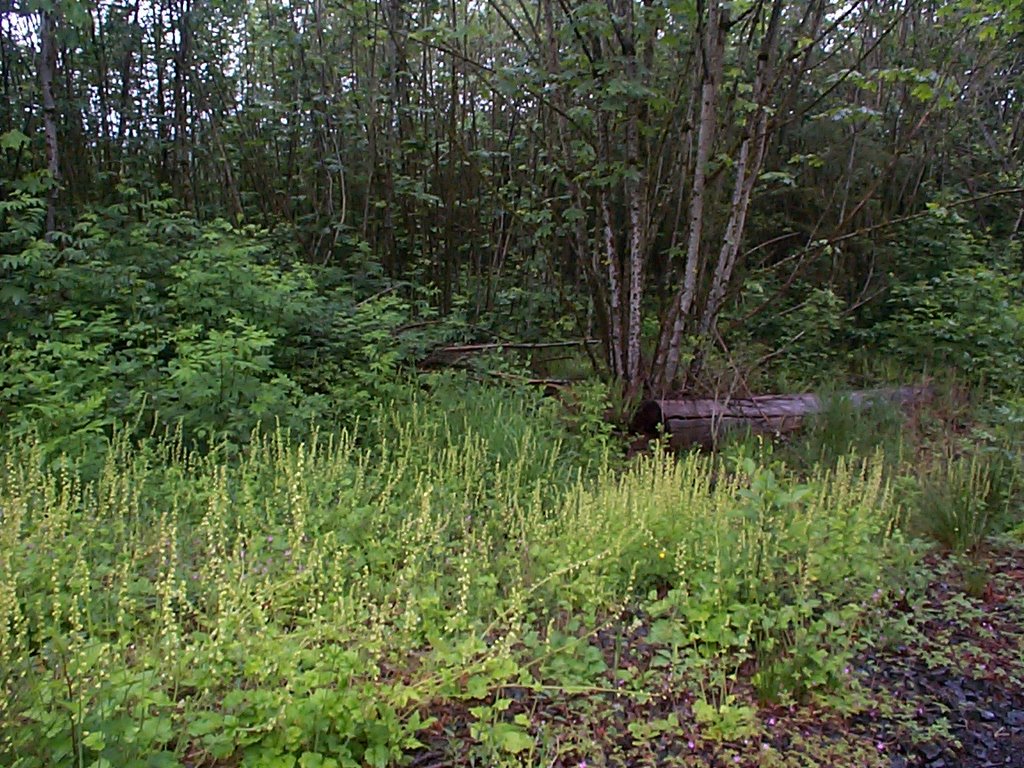 I can't wait to see what blooms next. One of the lilacs I planted shows up in front of the log as a forked white stem. It isn't doing so well. And I thought I could improve upon nature.
0
comments
Labels:
Plants
Sunday, May 28, 2006
Breakout!
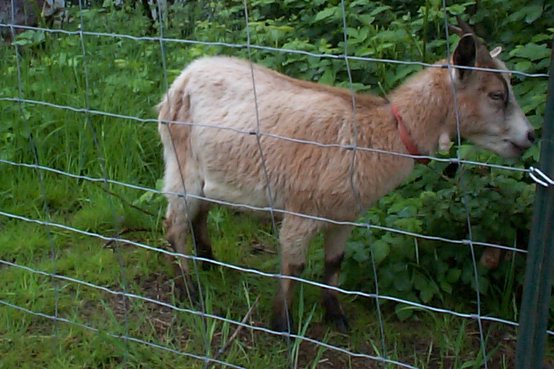
I've previously mentioned my Houdini goat, Nibbles. Here she is, the picture of sweet innocense. You'll notice, however, that she is on the lush side of the fence.

1 comments
Labels:
Goats
Foxtail Farm
 Due to sheep selection I may need to rename my farm from Ravenwood to Foxtail. These hardy plants are doing much better than the grass I'm trying to establish as pasture for my sheep and goats. This is a difficult task as I don't have enough fenced areas to give the grass a fair start, and of course the soil is heavy clay.
 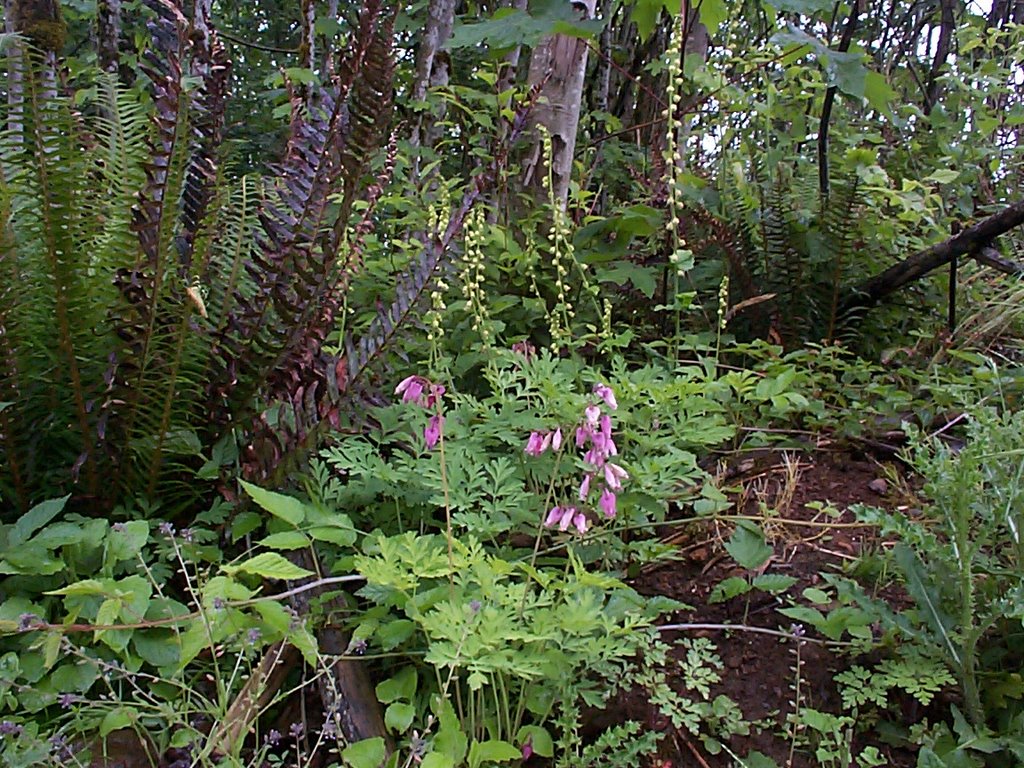 Elsewhere, in non-sheep areas, the foliage is highly varied. Obviously these other plants taste good to sheep. It's a good thing sheep don't like foxglove, as they are poisonous plants. I'm glad I don't have to scour the fields for plantlings. I will have to attempt to reduce their numbers, but I'll wait until after they've bloomed. They are beautiful.
1 comments
Labels:
Plants
Saturday, May 27, 2006
WildWatchCams
The Washington Department of Fish and Wildlife has a series of wildlife cams that are very interesting. I haven't seen my bald eagles lately, so I went there to view their Kent Eagle cam - and there's a chick! It looks like a chick in the Osprey cam nest too, but it's so rainy today it's hard to tell.
A fun way to spend some time on a wet Washington weekend.
Go to http://www.wdfw.wa.gov/wildwatch/eaglecam/
0
comments
Labels:
Stories
Thursday, May 25, 2006
Raven Young
A profusion of raven calls greeted me when I poked my head out the door last weekend. By the time I got down to the location of the fuss, all evidence of ravens had flown. However, the next day on my way to work I saw a young, bedraggled raven picking at the goose food on the side of the lane. That night he was on my neighbors covered car. By morning he made it to the garage roof, and from there to the house roof. He croaked mornfully, as if the world had abandoned him, banishing him to a wet and loney existence. I put food out for him, but got only raspy calls and suspicious looks. I last saw him in the trees next to the house. Hopefully the adult ravens I saw winging his direction were his parents, and he is now off learning how to earn a raven livelyhood.
0
comments
Labels:
Birds
Monday, May 15, 2006
Sunrise in Spring
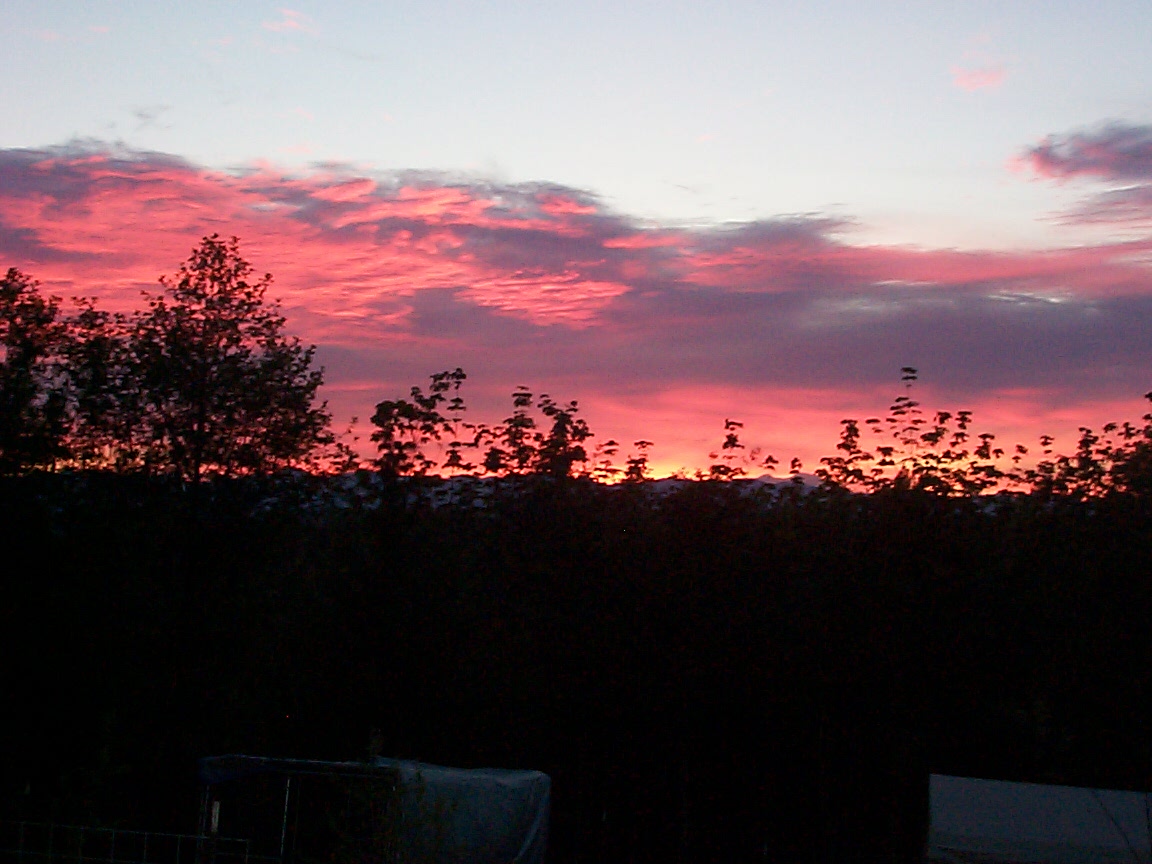 The weather is warm and sunny and the sun is rising over Mount Rainier - it must be spring. Lovely long days are the reward we receive for tolerating the damp, dark winter. The new resident swallows swoop past the window and the air is alive with birdsong. Glorious spring.
0
comments
Labels:
Stories,
View
Saturday, May 13, 2006
Low Flying Birds
I live on a narrow ridge on the way to the foothills of the Cascade Mountains. There are some interesting things that happen when you live on a ridge.
Birds flying from point A to point B are pretty determined about flying. Last winter while sitting at my computer I turned to look out the window. A Bald Eagle was flying by like a transport plane, just about at eye level. I went outside to see where he was heading, and saw him take a straight path almost due south.
Now that was strange - exciting, but strange. Eagles are magnificant creatures, especially when seen so closely and in flight. It wasn't until a couple weeks ago that the reason for the low flight occurred to me. I was about to get in my car when a Kingfisher flew by at eye level, about a foot from my nose. He didn't seem to notice me, the car, my dogs. Why would he fly by so low?
The birds are on their way somewhere, flying high above the ground and the trees. They come across a ridge, but as long as their path is still above ground and tree level, they don't adjust altitude. They just get very close to the ground at the top of the ridge.
So I get a birds-eye-view of the birds. Life is good!
0
comments
Labels:
Birds,
Stories
Saturday, May 06, 2006
Berry Delight
Blackberries, while good to eat, are a real problem in the Pacific Northwest. Anytime the soil is disturbed Himlayan blackberries take root. Today between showers I was clipping back vines. My goal was to clear out the area I see out the kitchen window.
As I started clipping and piling, my donkey brayed and the sheep baahed. What was I doing throwing away perfectly good food when they were obviously starving. So I moved down their direction (there are berries everywhere) and threw the branches next to the fence. Heads popped through the fence and devored the greens. The pigmy goat Nibbles (someday I will learn to not take animals people don't want anymore) aperated through the fence and helped clear the leaves so I could see the big vines.
At some point I realized I had stopped working at clearing out berries (a job) and started feeding treats to my animals (a joy). They've done a great job of clearing their field and a path outside the fence themselves. It doesn't look like their necks are 2 feet long, but a path that size exists that wasn't here last year.
When I started clearing a path to Jesse, who had taken a walk in the woods and gotten stuck on the other side of a briar patch, I got grumbles from the fenced crew. Jesse rescued, I came in for a late lunch, and the sheep wandered off. Nibbles levitated back into the field (I never actually see her get between places, but she seems to go at will).
I now have a much larger path, several berry-free moss-covered stumps sprouting huckleberries, and happy sheep. Another good day.
0
comments
Labels:
Stories
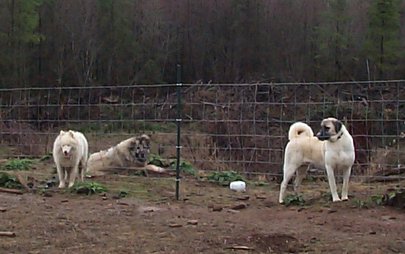
Keeping Watch
Tuesday, May 02, 2006
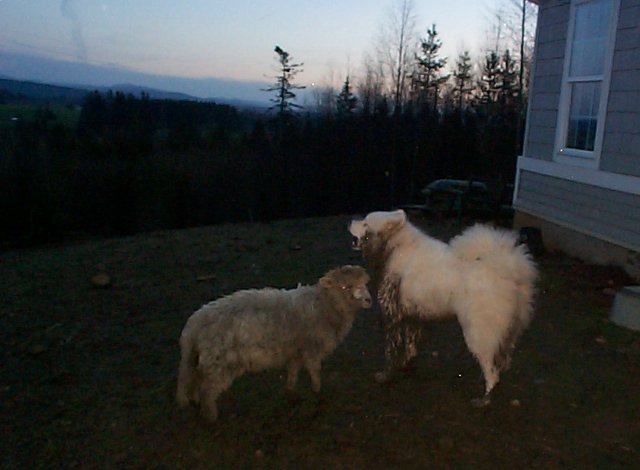
Samoyed at Sunrise

3
comments
Labels:
Dogs,
Jesse (Samoyed)
Swallow Rapture
It must be spring - the swallows have returned.
As I was putting Berna in her daytime abode I heard happy chattering. I turned to see four tree swallows gliding, diving and swooping around the eaves, over to the fir tree, up in the air. Chatter, chatter, chatter (that's how you can tell they are tree swallows). I'm hoping the swoops and chitters of delight mean they have decided this is home.
I'll go to work today a bit happier, a bit more aware of this wonderful world, this beautiful place that delights tree swallows. Swallows who dance their joy across the sky.
0
comments
Labels:
Birds,
Stories
Monday, May 01, 2006
Two Beauties - Maddie and Pele Grace
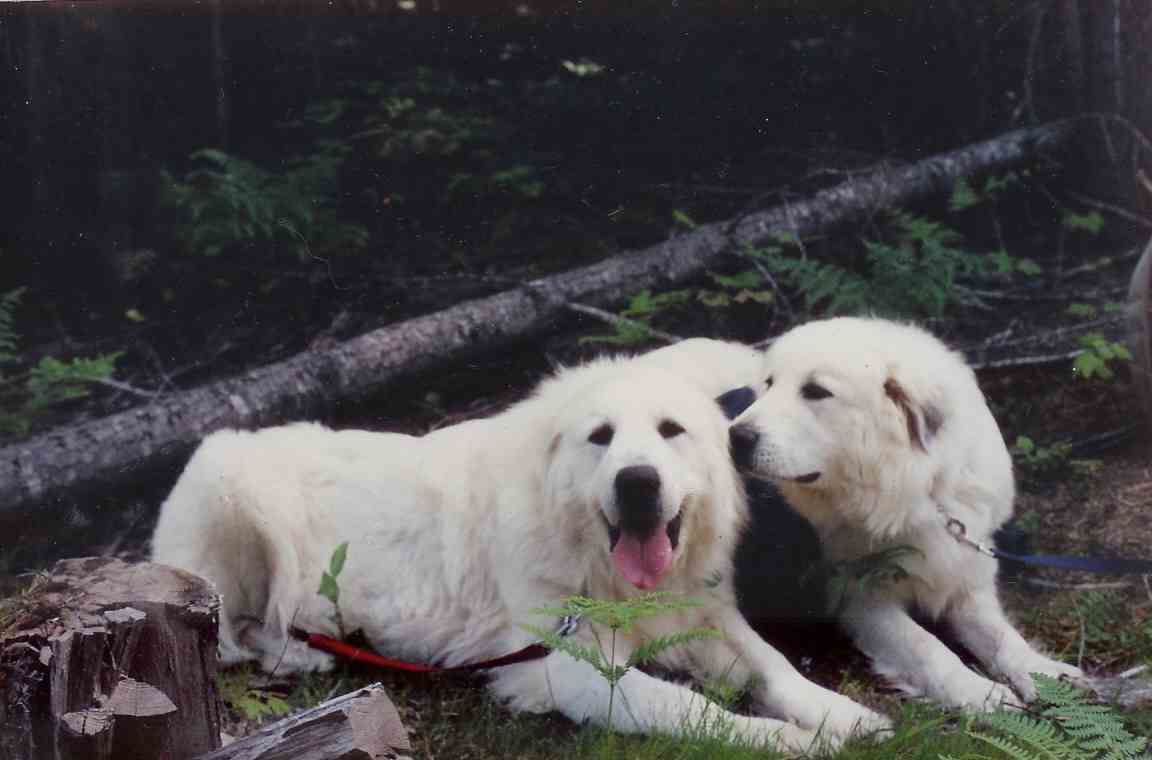 Great Pyrenees or Pyrenean Mountain Dogs
 ---
This morning I let Maddie out to splash in the ponds and get covered in mud as is her routine here (and not allowed at home
When I went out to feed the sheep, Maddie was in the loafing shed - vigilantly guarding one yearling doe (who didn't belong there), one ewe, and one newborn lamb. She wasn't disturbing the pair, wasn't trying to take over the lamb (a common problem with new guardians), she was just guarding. Then she would go out onto the bridge, bark a warning, and return. During the time I was feeding she did one full round of the field, a solid bark down the creek, and ended up back in with the new family. Looking very, very happy.
My dogs are much more casual these days about lambs. Drew was lounging on the hill that overlooks the entire sheep area, and Natasha was out patrolling the fence line. I think that as the oldest dog Maddie gets to call the shots on where her presence is needed.
Maddie is 8 years old, the mother of two litters. One of her pups was the 1996 and 1997 top winning Pyrenean in Finland, and a house and yard dog. A pup from her second litter is a full time Alpaca guardian in Alaska.
The first time I saw Maddie was in a show ring, at my first show. She is, however, from solid working lines. Maddie herself has several working 1/2 sibs. One of her mother's sisters guarded llamas until she died at the age of 12. Others worked in varying environments. Her mother's sire was not only a show champion and producer of champions, but had any number of pups who guarded successfully on both small family farms and large open range situations.
I would gladly take this show dog, house pet, and brood bitch as a working dog to protect my flock. Her instincts are obviously very much intact, she knows a job when she sees one, and does it. She can, and has, done it all.
0
comments
Labels:
Dogs,
Stories
Saturday, April 29, 2006

Working Livestock Guardian Dogs (LGDs)
Dogs have been used to protect livestock as long as people have been raising sheep and goats. Livestock Guardian Dogs live with and protect their charges, instead of herding them like Border Collies, Shelties, Corgies, and other herding breeds. They are large dogs, independent, and have definite minds of their own.
Traditionally, LGDs worked in conjunction with shepherds as flocks ate their way through the landscape. The use of dogs as flock guardians had dwindled by WWII, and after the war it was rare to see working guardians in Europe.
In the 1970s the USDA started experimenting with LGDs to prevent coyote predation of sheep, the Coppingers did research at Hampshire college, and several dedicated Great Pyrenees breeders started placing dogs into working situations, and learned how to support the livestock producers who took on their puppies.
The role of the working LGD in the United States is quite different from their historic roles. They and their charges are usually kept in fenced pastures without a constant human shepherd for backup. LGDs are used to guard a wide variety of animals - sheep, goats, llamas, poultry, and pretty much any critters that need protecting against predators. The predators are most often coyotes and loose dogs, although cougar, bear and even wolves threaten the more remote farms.
Of course, even those dogs kept as companions work. They protect their homes and people, and any other animals within their domain. This means they bark a lot. They make their own decisions, which means they are stubborn and tend to go deaf when what they hear isn't what they want to do. They don't take well to strangers on their territory. Wonderful dogs, but not for everyone.
0
comments
Labels:
Dogs
Wednesday, April 26, 2006
Sunny Day Dogs
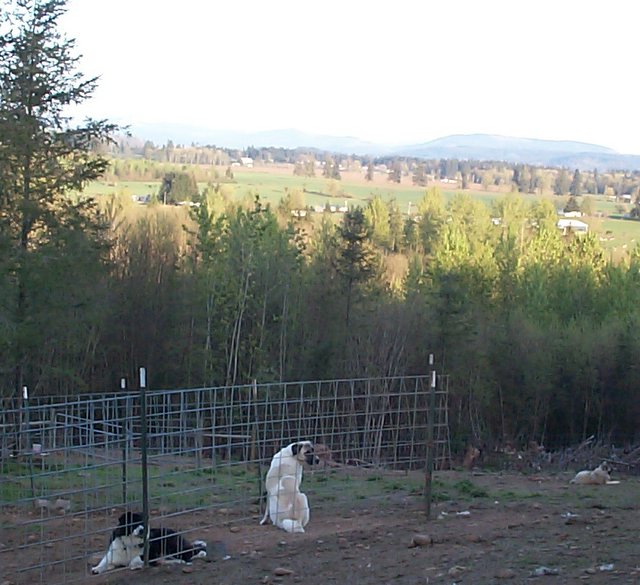
Berna and her mentor Hannah the Border Collie. Ursa is in the distance in one of her favorite spots, overlooking the sheep field and enjoying the view.

Ursa and Charlie strolling along the fence, each in a different field. The lamb was raised near the dogs, and now thinks he's a livestock guardian sheep.
0
comments
Labels:
Dogs
Sunday, April 23, 2006
Berna - Anatolian Shepherd Dog
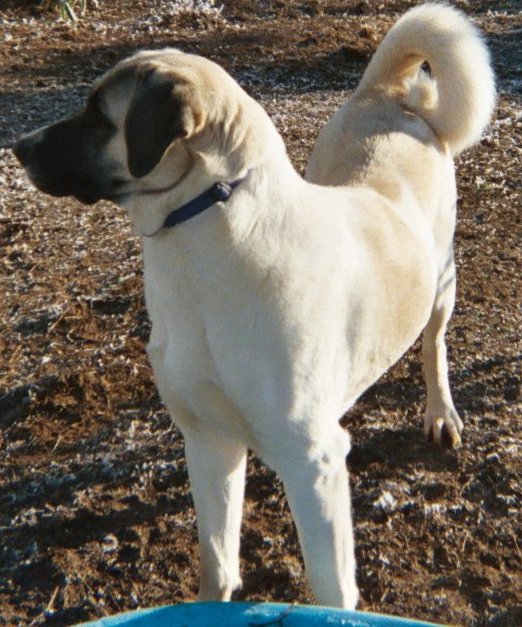
Berna is a guardian-dog-in-training. Isn't she lovely? Pinto markings aren't common for ASDs, but I think they are beautiful. Anatolians are the Turkish version of Livestock Guardian Dogs.
This summer my challenge is to teach her that birds are to be protected, not chased. She was raised by Hannah the Border Collie, and Border Collies think chasing is what life is all about. At two, Berna is maturing and calming, and I have high hopes for her working career.
1 comments
Labels:
Berna (Anatolian),
Dogs


 Posts
Posts